Coaches and group travel
What does a touring coach cost? Understanding a charter quote
Two quotes arrive for the same group trip, with a noticeable price difference. Before choosing the cheaper one, check what each covers: just the main journey, or the return travel, local excursions, drivers and days when the coach remains available? A price per kilometre helps when both calculations cover the same operation.
How much does hiring a touring coach cost?
A useful quote starts with the service: where the group leaves from, where it is going, the dates, passenger numbers and seating requirements. The operator also needs to know whether the coach will remain available at the destination and which local excursions it will cover. Those details turn a price into an offer for a specific trip.
There are three different calculations here. The purchase price is the investment required to buy the vehicle. The operating cost covers keeping it available and completing the journey. The charter price is what the customer pays for the agreed service. Dividing diesel expenditure by distance explains one component, but there is more to account for before reaching a quote.
If you are hiring, the practical question is: “What does this price include?” If you operate the fleet, it is: “Which costs must this trip cover?” We will follow both perspectives, using identified prices and a worked example you can replace with your own figures. All amounts below are in Brazilian reais, shown as R$.
How much does the coach itself cost to buy?
The investment helps explain the operation behind a charter. The examples below identify the vehicle, date and type of price. They show the scale of a purchase without constituting a Brazilian market average.
| Vehicle described | Condition and reference | Price in BRL | Type of price |
|---|---|---|---|
| Complete touring coach, chassis and body, supplied by Mascarello to Penápolis | New; contract in December 2025, delivery in March 2026 | R$ 1,390,000 | Documented public purchase |
| Marcopolo Paradiso G8 1200, Volvo B380R 4x2, 46 seats | 2023/2024; advertised mileage of 207,000 km | R$ 1,350,000 | Advertised asking price |
| Marcopolo Paradiso G8 1800 DD, Volvo B510R 8x2, 60 seats | 2023/2024; advertised mileage of 310,000 km | R$ 2,099,900 | Advertised asking price |
The advertisements were checked on 29 October 2026 and may change. Their prices and vehicle details were supplied by the sellers. For the Penápolis purchase, the municipality described the delivered vehicle as having 48 passenger seats, reclining seats, air conditioning and a lift. The public summary does not identify the exact chassis and body models.
This table does not measure how much more a DD costs than another type: age, use, configuration and purchasing arrangements differ. It shows an investment that needs to be recovered over the fleet’s working life. One tour does not pay for the whole purchase, but having a coach available has a cost even when it is stationary.
If you are buying or selling, FIPE provides a reference subject to regional, condition and accessory differences. Check the model, year and reference month, and whether the entry represents the complete vehicle being negotiated. None of the prices above is a FIPE quotation.
Why can a cheaper school bus be the wrong comparison?
Contract 005/2026 from Ouro, Santa Catarina, records R$ 560,000 for a Volare Attack 8 school bus with climate control and fixed seats in a 3x2 arrangement. It is a specification for another purpose. Comparing its price with a reclining-seat coach also means comparing what passengers will find inside.
Imagine spending the night and much of the following day on board. Recline, space, supports, luggage, toilet access and stops take on a different importance from a short school run. On a 40-hour itinerary, any saving needs to be considered alongside those needs and the drivers’ operating plan. Authorisation must also be checked for the transport service being contracted.
The label “school bus” alone does not describe every vehicle in that fleet category. Here, the documented fixed seats and configuration explain the difference. To compare accommodation, see executivo, semi-leito and leito seating; for the structure, explore DD, LD, HD coaches and minibuses.
Which kilometres belong in the calculation?
Imagine 800 km with your group and another 200 km between the depot, pickup points and repositioning. The coach will cover 1,000 km. An empty passenger area does not switch off fuel consumption or give the tyres a day off.
That is why a price per kilometre needs to state its distance basis. For a hypothetical R$ 9,240 quote for this operation, dividing by 1,000 km gives R$ 9.24 per total kilometre. Dividing by the 800 km with the group gives R$ 11.55. The service and total price are unchanged; only the denominator differs. Ask whether empty travel is included and how additional kilometres are charged.
Time matters too. Covering that distance in one day or keeping the coach available for three days creates different crew, accommodation and availability requirements. Include local excursions and waiting time in your request. “Drop us off and collect us on Sunday” and “stay with the group all weekend” describe different operations.
How many kilometres does a coach cover per litre?
For a useful estimate, link consumption to the vehicle and a comparable route. Load, terrain, speed, traffic and climate control are operating conditions to record. Knowing only that the coach is a DD or LD does not settle the estimate.
One identified example is a European test reported by Scania in 2017 involving a 12.1 m Touring HD. It recorded 18.2 L/100 km over 347 km, with air conditioning used for half the time, equivalent to approximately 5.49 km/L. That result belongs to that test; it is not an average for DD coaches in Brazil.
For your own fleet, use consistent distance and fuel records, noting occupancy and route. The calculation is estimated litres = total kilometres ÷ consumption in km/L. Then multiply by the fuel price used for the quote. The result is the estimated diesel cost, one of the trip’s expenses.
A worked example for the calculator
All figures in this section are hypothetical teaching inputs, not market averages, wage benchmarks or quotations. The example covers one trip by one coach: 800 km with the group, 200 empty kilometres, three days, consumption of 2.5 km/L and diesel at R$ 6.50/L. That requires 400 litres and R$ 2,600 of fuel.
| Hypothetical component | Calculation | Amount |
|---|---|---|
| Diesel | 1,000 km ÷ 2.5 km/L × R$ 6.50/L | R$ 2,600 |
| Drivers | 3 days × 2 people × R$ 200 per person/day | R$ 1,200 |
| Crew meals and accommodation | Estimated total for the trip | R$ 600 |
| Tolls and parking | Estimated total for the trip | R$ 800 |
| Maintenance and tyres | 1,000 km × R$ 0.90/km | R$ 900 |
| Fixed costs allocated to the trip | Consistent allocation of operating overheads | R$ 1,400 |
| Other costs, such as preparation and cleaning | Estimated total for the trip | R$ 200 |
| Cost subtotal | Sum of the components above | R$ 7,700 |
| 20% markup on the subtotal | R$ 7,700 × 20% | R$ 1,540 |
| Illustrative quote | R$ 7,700 + R$ 1,540 | R$ 9,240 |
The result is R$ 9.24 per total kilometre. The driver calculation uses the same daily cost for everyone over the same three days; meals and accommodation are separate. That driver count is an arithmetic input, not a suitable roster established by the example. Staffing depends on the route, stops and rest arrangements.
Notice the distinction between markup and margin: R$ 1,540 is 20% of the R$ 7,700 cost, but approximately 16.67% of the R$ 9,240 price. It is not guaranteed profit. Applicable taxes, commissions, ARLA 32, a guide, cleaning and other expenses must be included in your inputs. Anything omitted leaves the result incomplete.
For your own fleet, allocate fixed costs consistently. Insurance and fleet renewal, for example, should not reappear in several parts of the same calculation. Adding the entire repayment of a loan’s principal to depreciation as if they represented two separate kinds of wear duplicates part of the cost.
Open the coach charter cost calculator and choose “Load example” to follow these figures. You can calculate on the site and download the Portuguese Excel workbook after registering. All values remain in Brazilian reais. For several coaches, calculate each separately and add the results.
How much is that per passenger?
For the hypothetical R$ 9,240 quote, 40 paying passengers share the transport cost at R$ 231 each. With 25 paying passengers, it becomes R$ 369.60. The coach completes the entire route in both cases. Those amounts cover this transport only; hotels, admission tickets and other package services have their own costs.
Use a realistic sales forecast and the confirmed vehicle capacity. Crew seats, blocked seats and places absent from that layout cannot count as paying passengers. Organising seats and bookings helps make that distinction visible before boarding.
For an agency receiving a fixed quote from the operator, the transport budget starts with that contract and genuinely agreed extras. If fuel and drivers are already included, adding them again counts the same operation twice. Fleet costing and the group-tour budget are different perspectives on the same service.
Have a more useful conversation with the operator
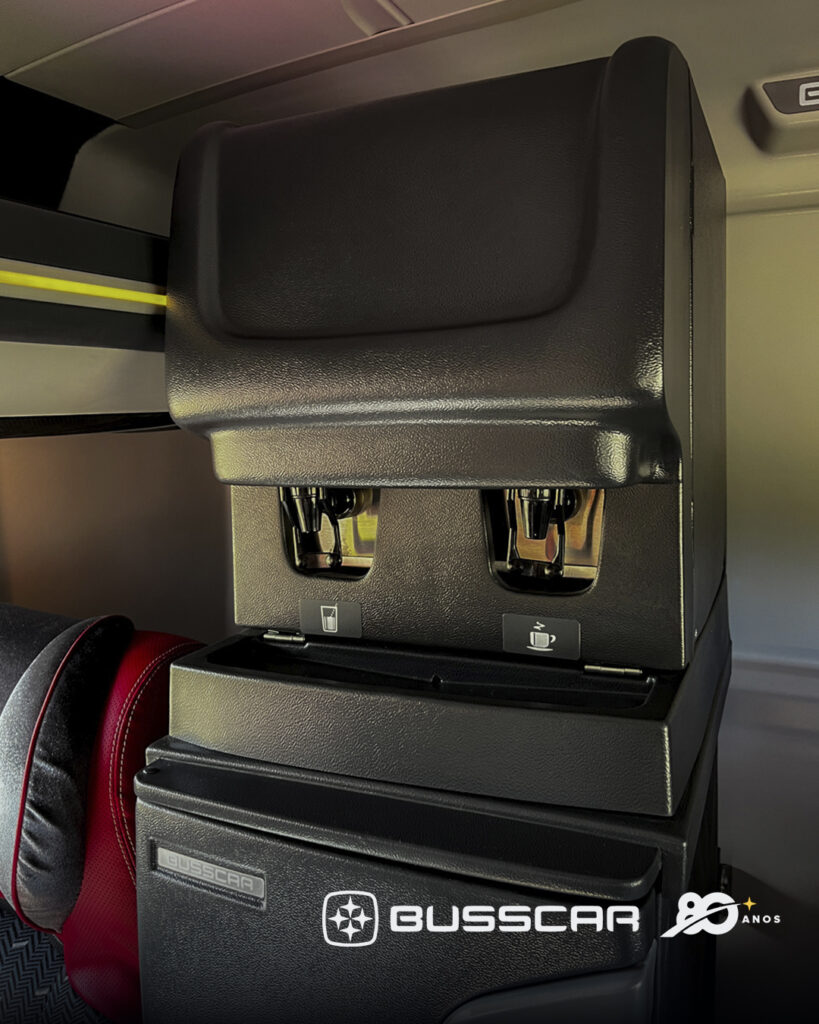
Ask the quote to identify the vehicle, seating, working equipment and included services. Confirm dates, timings, kilometres, local excursions, waiting time, crew, tolls, parking and replacement arrangements. A fridge does not establish who supplies the drinks; screens do not establish the entertainment programme. The guide to brands, bodies and equipment helps you frame those questions.
For vehicle operators, OnWay Fleet, the fleet module, brings together fleet records, availability and charter quotes with PDF output. For tour organisers, OnWay Expeditions, the trips module, organises bookings, passengers and finances by trip and passenger. The contracted transport can then be planned alongside the other services.
OnWay is evolving. Contact us on WhatsApp to explore the modules, explain how you prepare quotes and ask about available features. The conversation is about software for managing your operation, based on how your agency or fleet works.
Frequently asked questions
What is the average purchase price of a touring coach in Brazil?
The examples do not form a national average. They include one public purchase and advertised asking prices, identified by date and configuration. Compare body, chassis, year, use and condition when buying.
How much does a coach charter cost per kilometre?
It depends on the vehicle, total distance, days and service. The example’s R$ 9.24/km is a hypothetical R$ 9,240 quote for 1,000 km, not a market rate.
How much fuel does a DD coach use?
DD does not determine a single fuel-consumption figure. Use the vehicle’s records on comparable routes, considering load, terrain, speed and operating conditions.
Does the per-kilometre price include empty return travel?
The quote should make that clear. Check depot travel, pickups, repositioning, included distance and excess-kilometre charges. The calculator divides by total kilometres, including empty travel.
Does a 20% markup mean a 20% profit margin?
No. In the example, 20% of R$ 7,700 adds R$ 1,540, producing R$ 9,240. The markup is about 16.67% of that price, before any omitted costs or taxes.
Can I use the calculator if I receive a fixed charter quote?
If the operator already includes fuel and crew, do not add those costs again. Use the fixed quote and agreed extras in the tour budget. The detailed calculator helps estimate the operator’s costs.
Do I need to register to calculate?
You can use the calculation on the website. Registration is requested separately to download the Portuguese Excel workbook.
Sources and research method
Sources accessed on 29 October 2026.
- Penápolis: contract 289/2025. Purchase of a complete new touring coach for BRL 1,390,000, signed on 12 December 2025. Accessed 29 October 2026.
- Penápolis: coach delivery to the Sports Department. 6 March 2026: purchase confirmation and description of 48 passenger seats, air conditioning and accessibility equipment.
- Classi Ônibus: Paradiso G8 1200, Volvo B380R, 2023/2024. Asking price observed on 29 October 2026: BRL 1,350,000. Year, mileage and capacity are seller-provided; this is not a transaction price.
- JM Utilitários: Paradiso G8 1800 DD, Volvo B510R, 2023/2024. Asking price observed on 29 October 2026: BRL 2,099,900. Seller-provided information; this is not a transaction price.
- Ouro, Santa Catarina: contract 005/2026 for a Volare Attack 8 school bus. BRL 560,000 purchase with a school specification, fixed 3x2 seating and air conditioning.
- FIPE: average vehicle prices and lookup guidance. Explains the reference nature of its figures and reasons for variation. No individual FIPE valuation was used in this article.
- Scania: Touring excels in fuel consumption. Manufacturer's 2017 report of a European test: route, consumption and partial use of air conditioning. It is not a Brazilian fleet average.