Coaches and expeditions
Executive, semi-sleeper or sleeper: which coach should you choose?
The photo looks good and the quote says “fully equipped”. Now look at where you will spend the journey: the seat, the space around it and the services that will actually be available.
Three quotes on the table. How do you choose?
You have asked for a coach for your group and received executive, semi-sleeper and sleeper options. Which will give everyone a more comfortable night? Start with the seating: how far the backrest reclines, what support it offers and how much room remains when the person in front wants to rest too.
In Brazil, the names executivo, semileito, leito and cama describe seating and the service offered. DD means two decks; G7 and G8 identify generations of Marcopolo coach bodies. These tell you different things. A G8 DD can have more than one seating class, and the body name alone cannot describe your overnight experience. Our guide to touring coach types explains the labels.
Give each supplier the same starting brief: destinations, timings, passenger numbers, luggage and planned nights on the coach. That makes the quotes answer the same question. A layout that works for a daytime outing deserves another look when the return journey includes a full night on the road.
Executive, semi-sleeper, sleeper and cama seats
Begin by comparing the resting position and the space available. Brazil has a useful official reference: the ANTT comfort classification form used for regular interstate services. It relates seat class to recline and clearance from the seat immediately ahead. That is the scope of this table. A charter quote still needs to describe the actual seating behind its commercial labels.
| Seat class in the Brazilian form | Minimum recline from vertical | Minimum DPA |
|---|---|---|
| D: executive | 40° | 26 cm |
| C: semi-sleeper | 45° | 28 cm |
| B: sleeper | 50° | 37 cm |
| A: cama, or bed-style seat | 80° | 48 cm |
| E: basic | No minimum angle shown | 26 cm |
DPA is the minimum distance to the seat immediately ahead, measured as specified in that form. It is neither seat width nor the distance between row mounting points. The angle also needs a reference: an advertisement saying “160 degrees” may measure recline differently. It cannot be compared directly with 80° from vertical.
A side photo with the seat reclined helps turn those numbers into something you can judge. Ask for one showing the row ahead reclined as well. Look at the supports too: a footrest supports the feet, while a leg rest provides a longer supporting surface. On an overnight journey, that distinction deserves more attention than the upholstery name.
If you can see the vehicle, sit down, recline and check your leg position and access to the aisle. Otherwise, ask for current photos or a video demonstration of the layout you are booking. Any quoted recline angle should refer to that identified seat and explain how it was measured.
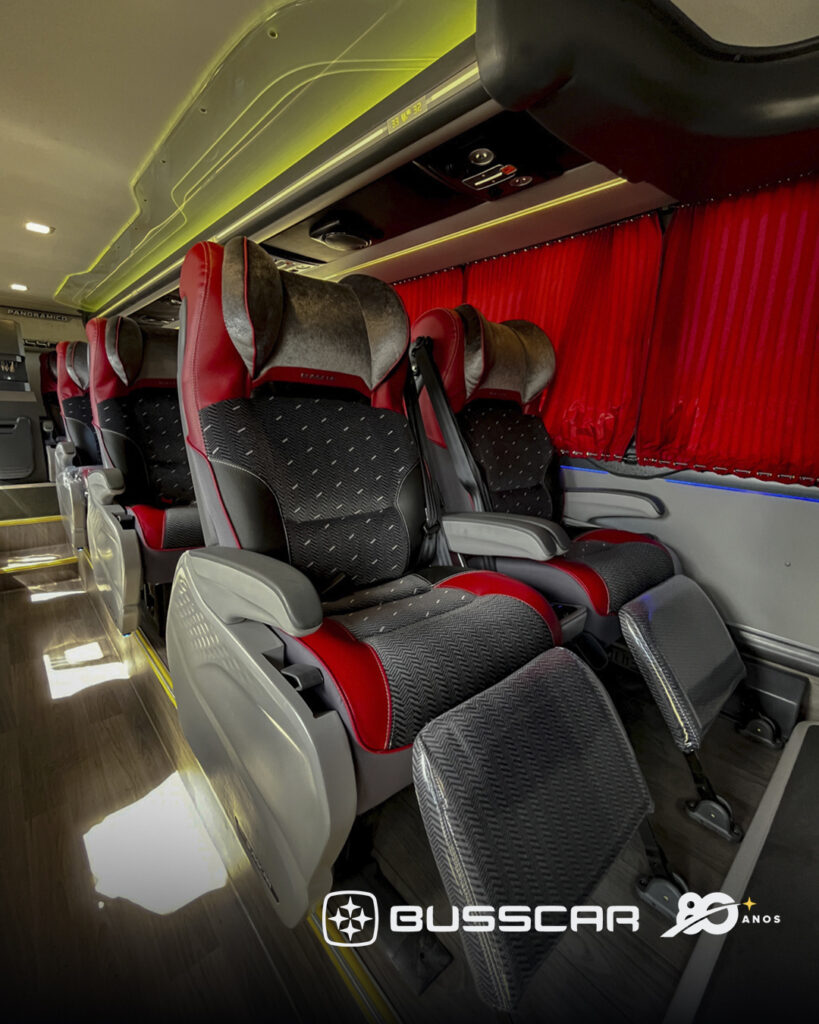
2+2 or 2+1: where will you sit?
The numbers describe the seats on either side of the aisle. In 2+2, there is a pair on each side. In 2+1, there are two seats on one side of the aisle and one on the other. A couple may prefer the pair; someone travelling alone who wants no immediate seatmate may value the individual seat.
This arrangement does not tell you the seat width or spacing between rows. Nor does it define the class by itself: the Comil Invictus HD catalogue lists both Leito 2x1 and Leito 2x2 options. You need the full configuration to judge the offer.
There is a commercial choice here for organisers. In a hypothetical example, removing rows may allow a different seating arrangement, but it also leaves fewer places to share the trip cost. Before choosing by capacity alone, consider what your customers value: price, privacy, rest or a mixture of all three.
The actual coach seating plan brings this together. It lets you locate your seat, the last row, stairs and equipment. Use the confirmed vehicle's layout before allocating bookings: coaches with the same model name can have different interiors and numbering.
On a double-decker, look inside both decks
A double-decker can combine different seating classes. Marcopolo documented Viação Garcia configurations with semi-sleeper seats upstairs and leito-cama seats downstairs. Your booking needs to identify which accommodation you are buying.
If you want the lower deck to reduce stair use, trace the whole journey inside: entrance, seat and toilet. For each deck, confirm the access arrangements and whether it has a toilet; if the toilet is elsewhere, understand how to reach it. Accessibility also needs checking on the actual vehicle, including boarding and seating arrangements.
Equipment locations vary. In the same publication, Marcopolo describes a 40-seat Leito Plus layout with its toilet upstairs. The Panorâmico DD NB1 delivered to Igapetur is described with a downstairs toilet. Neither position is a rule for every double-decker.
A single-deck coach can also offer a well-specified place to rest. In September 2026, Busscar announced Vissta Buss 365 NB1 vehicles for Penha with 42 seats, Class Leito Turismo seating, leg rests and footrests. Compare the seating delivered. Counting decks will not settle the choice.
Fridge, coffee maker, TV and USB: what do you get?
An equipment list becomes useful when you know how you will use each item. A fridge can keep drinks cool; the quote needs to say which drinks will be provided. The same applies to coffee and entertainment: installed equipment and the service you buy are two parts of the discussion.
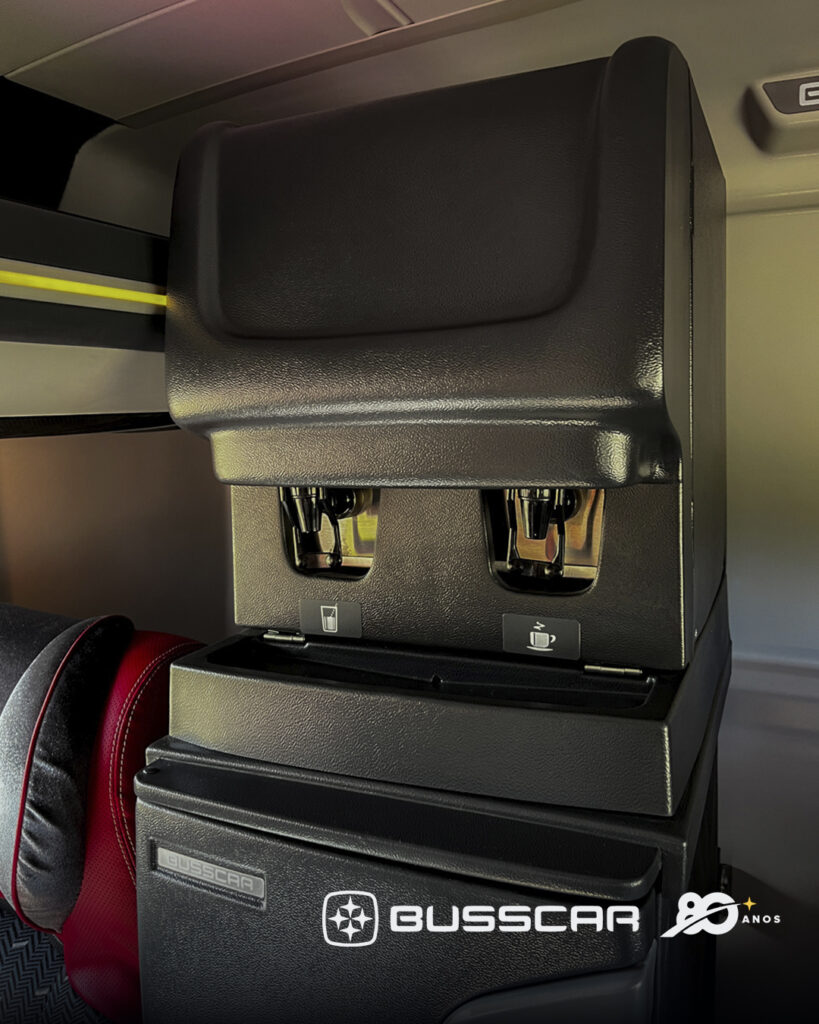
There are documented examples to work from. The G8 1800 DD delivered to Marcelo Turismo in November 2025 was announced with a coffee maker, fridge, water dispenser, monitors and USB-A and USB-C connections. The Garcia configurations discussed above included 110 V power sockets. These details belong to identified deliveries; they give you something concrete to compare without assuming every coach of that model has the same equipment.
| Advertised item | What it can do for the trip | What to agree |
|---|---|---|
| Minibar fridge or refrigerator | Store food or drinks in the available cooling equipment | Location, access, capacity and who provides the contents |
| Coffee maker | Prepare or serve coffee, depending on the equipment and service | Operation, water and supplies, who serves and when |
| TV or monitors | Show the content planned for the journey | Programme, sound and usage times, especially overnight |
| Air conditioning | Control the passenger saloon climate | Areas served, working condition and available adjustments |
| USB | Charge compatible devices | USB-A or USB-C, location and output specifications |
| Power socket | Power equipment compatible with the installation | Stated voltage, such as 110 or 220 V, and permitted power draw |
| Reclining seat | Change your seating position | Seat model, recline, supports and space with the row ahead reclined |
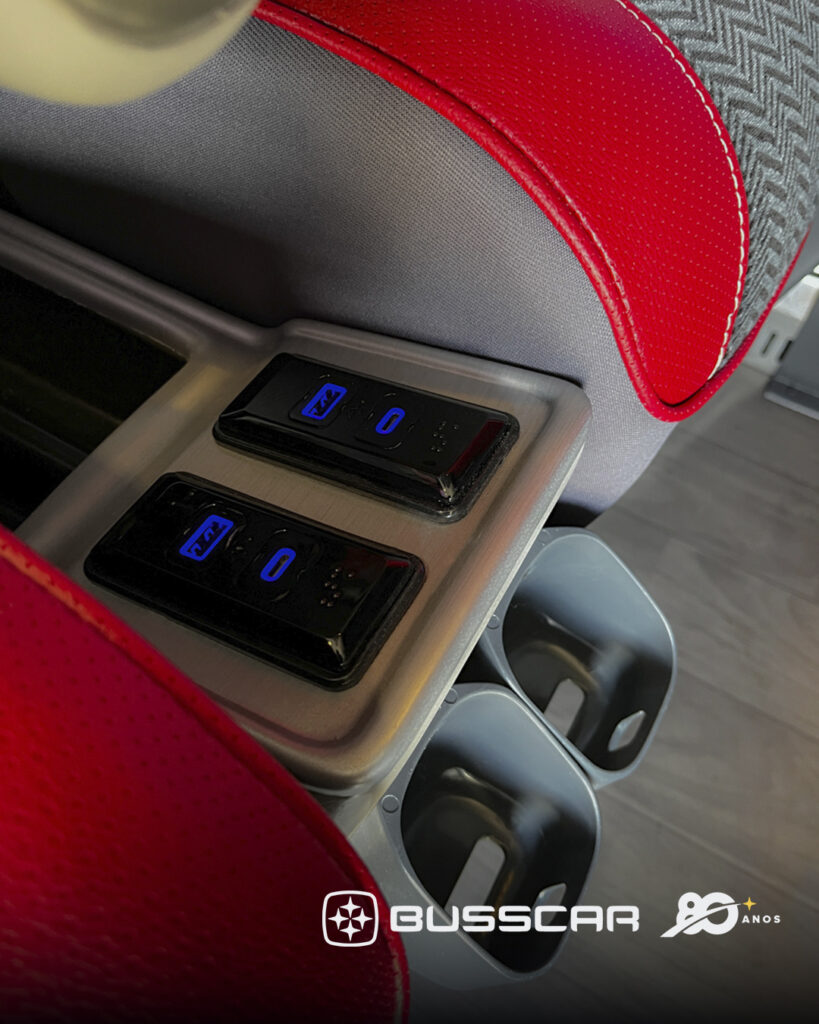
If you need to charge a laptop, “USB available” does not settle the question. Compare your device's power requirements with what is provided. For organisers, turn these details into a clear description of what is included. “TV onboard” tells travellers there is a screen; the programme and viewing times still need agreeing.
Air conditioning helps with heat. Check the rest too
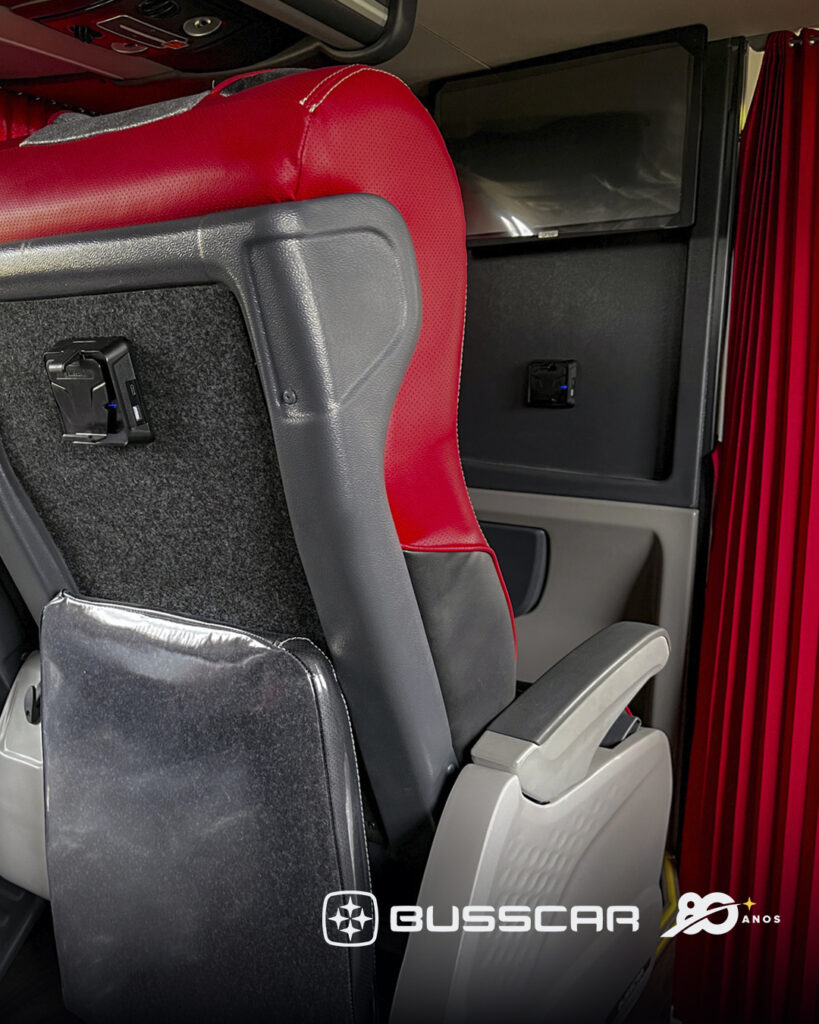
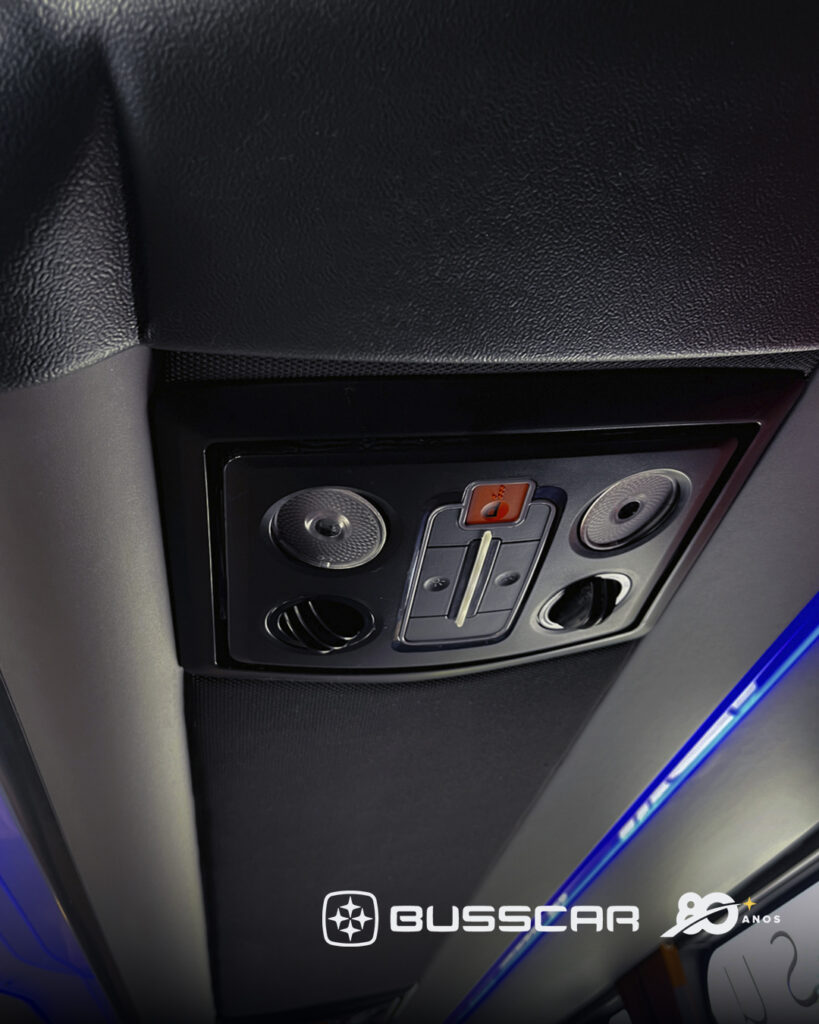
Air conditioning deserves attention, but it does not create more legroom. Assess both separately. It is also worth unpacking “individual air”: passengers may be able to change the direction or flow at the outlet above their seat. That does not necessarily give each person a separate temperature control.
The Thermo King operator's manual distinguishes cooling, ventilation and outside-air control. Cooling the cabin and bringing in fresh air are different functions. The Brazilian Spheros CC336 and CC356 specification lists fresh-air renewal and heating as options. Availability depends on the installed system.
“Roof-mounted” describes an installation position; “ducted” describes how air is distributed. A system can be both. Its operation, distribution and condition tell you more about the coach you are hiring than either label or nominal capacity alone.
On a double-decker, confirm coverage on both decks. For a route through colder places, check whether heating is included. A demonstration and maintenance information help you assess the actual vehicle, without inventing a filter replacement schedule that applies to every system.
Why does a 40-hour journey call for a different choice?
On a journey that long, your seat becomes more than a way of reaching the destination. It is part of the night, quick meals and many hours spent together. Recline, supports, space, lighting, toilets and stops carry more weight. Knowing how many nights you will spend in transit helps you decide whether the seating fits the trip you want.
This is why comparing a school bus solely on price or seat count can lead to the wrong choice. Brazil's FNDE Caminho da Escola programme supports students' access to education, including in rural areas. An expedition carrying adults, luggage and overnight travellers has different seating and service needs.
School vehicles are not all alike. Volare presented Fly 9 school buses in Macaé in August 2026 with air conditioning and accessibility features. Air conditioning alone cannot tell you whether the seats and the wider setup support the planned rest. Consider the vehicle's purpose and configuration, rather than its colour.
For an expedition with nights onboard, we recommend prioritising a touring coach whose seating and operation suit the route, while also comparing an overnight hotel stop. There is no universal hourly cutoff in this comparison that makes one seat class compulsory. The service needs to fit the journey, including the driver roster, stops and rest periods.
Choose for the route, then carry the details into the booking
For an airport transfer, luggage space and easy boarding may decide the hire. On a day trip, remember that the group still has the return journey after the outing. On an overnight journey, look closely at the reclined seating. The table gives different priorities to the same equipment list.
| Type of trip | Comparison priority | What to look for in the quote |
|---|---|---|
| Transfer or short outing | Boarding, access and luggage | A vehicle suited to the group, bags and destinations |
| Day return | Seating in both directions | Total seated time, supports and return schedule |
| Night on the coach | Conditions for resting | Reclined seat, space, lighting, climate control, toilet and stops |
| Long expedition | The full service | Rest, luggage, crew, support and any hotel stops |
Suspension and vehicle condition belong in the assessment too. Mercedes-Benz explains how full air suspension contributes to levelling and reduces the transfer of jolts. Knowing the chassis helps, alongside assessing the particular vehicle and route. Noises noticed during a viewing or demonstration are worth discussing with the supplier.
After choosing, keep the vehicle identification, layout and agreed specification with your supplier information. In your seat and booking records, the selected accommodation needs to stay linked to the passenger. If the coach changes, check its interior before treating the places as equivalent.
For trip organisers and fleet operators, OnWay Fleet, the fleet module, brings together vehicles, seating layouts, driver records, document expiry dates and maintenance records. OnWay Expeditions, the trips module, organises trips, passengers, bookings and operational information. That helps carry the choice made at quotation stage through to the people preparing boarding.
The platform is evolving. To understand which features fit your operation, talk to OnWay on WhatsApp about Fleet and Expeditions.
Frequently asked questions
Does every sleeper coach have a 2+1 layout?
There is no universal commercial rule. The Comil Invictus HD catalogue, for example, lists Leito 2x1 and Leito 2x2. The layout tells you how many seats are on each side of the aisle; also check dimensions, supports and the configuration being booked.
Do a fridge and coffee maker mean drinks are included?
The equipment does not define the trip's service. The quote should explain drinks and supplies, who provides and serves them, conditions of use and any charges. That tells you what to bring and what will already be available.
Is USB the same as a 110 or 220 V power socket?
They are different connections. Check the USB type and output specifications or, for a power socket, the voltage and permitted power draw. The advertised installation needs to be compatible with the device you plan to use.
Can a smaller coach suit a long journey?
It can be an option if its configuration and operation suit the route. Size alone does not decide: compare seating, luggage space, access, climate control, the group's needs and planned stops.
Can I choose my seat from a photo of another coach of the same model?
Use the plan and photos of the confirmed vehicle or configuration. The same model can have different seats, numbering, capacity and equipment. On a double-decker, check your accommodation, access arrangements and the toilet's location relative to your deck.
Sources and research method
Sources accessed on 29 October 2026.
- ANTT: declaration of seat comfort classes. Form referring to Article 81 of Resolution 6,033/2023 for Brazilian scheduled interstate services.
- Comil: Campione Invictus HD brochure. 2022 brochure showing alternative seats and seating arrangements.
- Marcopolo: G8 vehicles delivered to Viação Garcia. Configurations of vehicles actually delivered; they do not represent every unit.
- Busscar: Vissta Buss 365 NB1 coaches for Penha. Delivery announced on 9 September 2026.
- Spheros: CC336 and CC356 technical specifications. Brazilian technical data sheet, June 2020 revision.
- Thermo King: Bus HVAC Operator’s Manual. Operator’s manual, Revision A, June 2020.
- Volare: school fleet renewal in Macaé. Vehicles presented on 4 August 2026.
- FNDE: Brazil’s Caminho da Escola school-transport programme. Institutional purpose of the Brazilian programme.
- Mercedes-Benz: touring coaches and charter services. Manufacturer’s explanation of air suspension.
- Busscar: Panorâmico DD NB1 delivered to Igapetur. Delivery announced on 12 June 2026; documents the downstairs toilet and equipment of the identified vehicle. Accessed on 29 October 2026.
- Marcopolo: Marcelo Turismo G8 1800 DD. Delivery announced on 24 November 2025; documents the coffee maker, fridge, water dispenser, monitors and USB-A/C in this configuration. Accessed on 29 October 2026.